
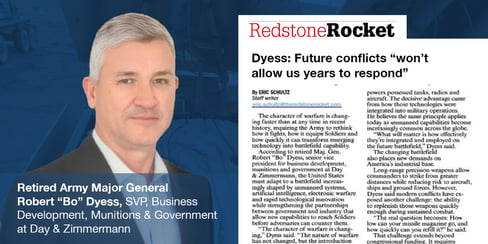
Retired Army Major General Robert “Bo” Dyess, SVP, Business Development, Munitions & Government, Day & Zimmermann was recently featured in The Redstone Rocket’s Space & Missile Defense coverage, sharing his perspective on how rapidly evolving technology is reshaping the battlefield—and what that means for the U.S. military and defense industrial base.
“The character of warfare is changing,” Bo told The Redstone Rocket. "While the fundamental nature of war remains constant," he explained, "the proliferation of unmanned aerial, ground and maritime systems—combined with advances in intelligence, surveillance and reconnaissance, artificial intelligence and electronic warfare—is transforming how wars are fought."
 For the United States and its Allies, keeping pace will require more than developing new technology. It will require rapidly integrating emerging capabilities, getting them into warfighters’ hands and ensuring the industrial base has the capacity and skilled workforce to sustain them.“
Future conflicts won’t allow us years to respond, they’ll require us to adapt in months, or even weeks,” Bo said.
That urgency extends to the Nation’s munitions requirements. As long-range precision weapons become increasingly important to modern operations, Bo emphasized that production capacity and replenishment are becoming strategic considerations in their own right.“
The real question becomes: How low can your missile magazine go, and how quickly can you refill it?”
Bo also addressed the rapidly expanding role of unmanned systems and the challenge of countering inexpensive drones without relying on disproportionately expensive interceptors. The solution, he noted, will require a combination of electronic warfare, directed energy, improved sensors, layered air defense and continued innovation across government and industry.
Yet technology alone will not determine who maintains the advantage.“
At the end of the day, technology doesn’t determine the outcome by itself. People do.”
That includes the Soldiers who must integrate new capabilities on the battlefield as well as the welders, electricians, machinists, engineers and other skilled professionals who make those capabilities possible. Bo called rebuilding America’s advanced manufacturing workforce a national priority and emphasized the importance of education, vocational training, apprenticeships and community colleges in strengthening the defense industrial base.
He also highlighted Huntsville and Redstone Arsenal as a model for the kind of close government-industry collaboration needed to accelerate innovation. With military organizations, acquisition commands, researchers, engineers, testers and defense companies concentrated in one ecosystem, the region can help move capabilities from concept to the warfighter more quickly.“
The Huntsville area is really a national treasure,” Bo said.Bo’s message reflects a challenge Day & Zimmermann is actively preparing to meet: anticipating the munitions requirements of our Nation and our Allies as the character of war changes. From warheads and fuzing to the emerging requirements created by unmanned systems, we are focused on providing the efficiency, capacity, and capabilities warfighters need to win on current and future battlefields